20 March 2013

Transhumanism- No Longer Just For Cyborgs

"Man is a beautiful machine, that works very badly.
- H.L. Mencken"

Of late, I've noticed that people seem immensely preoccupied, at least on the internet, with comparing their "achievements" in the gym with those of others.  Numerous benchmarks have been bandied about as indicators of a particular level of strength, all of which I've found to range between laughably low and downright embarrassing.  It would seem that this is because everyone appears to be very preoccupied with comparing themselves to an average, which is never a good way to determine excellence, and it's either a salve to the ego of someone who sucks at lifting or completely inconsequential to someone who doesn't.  In either case, they're pointless.  For those of you who are blissfully unaware of the existence of these charts, here they are (ladies, the misogynist who made this chart apparently felt that you are undeserving of a chart... of which you should probably be glad):


I find this one particularly funny, because according to it, I was a pro level lifter before I'd even had a sip of protein powder as a 134 lb wrestler.  I was that strong not because I'm a freak, but because I trained 6 days a week with people a hell of a lot bigger and stronger than myself... and I actually put some effort into lifting.
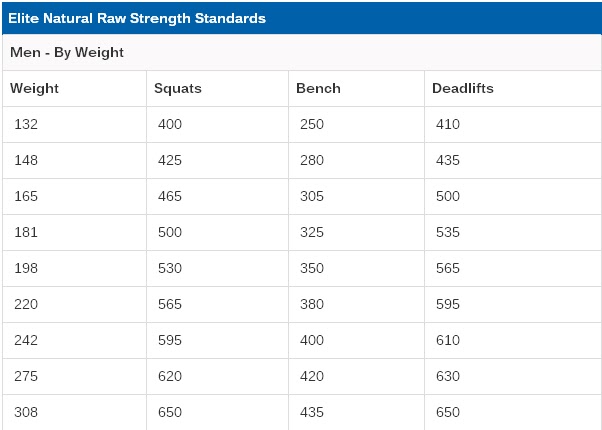
 
These seem to make sense if you're the type of person who needs a benchmark against which to gauge your success, but if you get validation out of a chart you're probably one rainy day away from throwing yourself off a fucking bridge anyway.  Thus, anyone who falls into that category should start working on their jump squats so they can do it right.

This chart would be more aptly called "If This Means You're Strong, The Apocalypse Is Nigh".

Now we're starting to enter the land of funny.  If you bench less than 225 at any bodyweight as a male over the age of 15 who has two working arms, your name should not exist anywhere in conjunction with the word "strong", let alone "very strong".  This category should be called "Bitch Mode".

This shouldn't even be a chart, and if you're on it, you're not a person. 

Weirdly, for the pre-internet generations, the only benchmarks in the gym were beating gym records, beating your friends' best lifts, and adding another 45lb plate to any lift.  Those were cool milestones in retrospect, but hardly our overarching goal- we just liked lifting and knew strength would result naturally out of training.  Our milestones arose out of having fun in the gym, and trying to be better than everyone else, rather than simply trying to reassure ourselves that we didn't suck.  If you're looking to the internet for validation that you don't suck, here's a newsflash- you suck harder than any other person whose lifetime predated the internet.

There might have been a healthy serving of this from time to time.  We didn't give a shit- we were trying to fucking move weight.  The only way you avoid failing hilariously in the gym is if you never fucking try.

For instance, I started out with a sub-135 lb bench as a freshman in high school.  During my sophomore year, I took a weightlifting class and began competing on bench and weighted dips with another guy about my weight.  We benched 3 to 5 times a week, using ever angle on the bench, rep range, volume, and chest exercise permutation of which we could think.  By the end of that year, we were both benching 255 with regularity, and by the time Thanksgiving of my junior year rolled around, he hit 300 on the bench and I hit 285.

The upper body weakness of the members of Reddit's /r/fitness amuses her greatly.

We're not the only people I've seen make those jumps, either.  My girlfriend Krista, who grew up chubby as hell and totally unathletic, took up Olympic weightlifting her junior year in high school and continued through last year.  During that time, she never benched.  When she started benching in August of last year, she maxed out with a bounced touch-and-go 85lbs at a bodyweight of about 140.  She's now "strong" by the standards of the dumbass charts above for men because she's been training her ass off at the lift for 6 months and is now hitting paused singles at 155 at a bodyweight of 130.  That's right, she got leaner and much stronger in 6 months by busting her ass in the gym and dieting hard.


In college, my 150 lb rock climber roommate went from a 225 lb shitfest of a deadlift to 405 for ten in one year, and he never even took a protein supplement.  He just deadlifted and did pullups four or five days a week for a year.  He and I even got a kid we hated to squat 225 for a double after 6 months of training when he'd never squatted before in his life, and literally folded up like an accordion under 135 the first time he squatted.  Another guy in the gym at the time did an unassisted liftoff and touch and go bench of 495 at a bodyweight of around 250 and wouldn't even let anyone stand nearby to spot... just because it was badass.  This is how people get fucking strong.

I guarantee Mike Matarazzo never guaged his arm size against that of the average man for inspiration.

Your goal in life should never be to do "as well", be "as good", or work "as hard" as any other person.  Instead, you should be striving to overachieve at all times- this is how humanity has lurched forward even while monomaniacal assholes, religious zealots, and harbingers of economic doom wrought havoc on society at large.  Measurement by a standard set by the average person leads only to mediocrity, socialism, venereal disease, and eventual burial in an unmarked grave.  Transcendence of the human condition, however, leads to every extreme of which you could think- fame, infamy, riches, poverty, brilliance, insanity, super strength, and crippledness, but no matter what the goal, those people will be remembered for their efforts.  It's hardly a matter of what other people are doing that drives you forward, as other people are inconsequential nothings, motes of dust, and a possible minor irritation in the quest to achieve greatness, whether that greatness come in the form of intellectual or physical pursuits.

"Every normal man must be tempted, at times, to spit on his hands, hoist the black flag, and begin slitting throats."
- H. L. Mencken

Since time immemorial, man has striven to transcend the human condition. Ancient people revered those who did so as gods, and they then became immortalized in the writings of the time.  Thus, the ancient warriors who served as the Michael Jordans of the battlefield are still remembered today, as Achilles and Ajax, Gilgamesh and Herecles.  Even at that time, humans looked for ways to vastly outdistance the performance of their peers, as we are a naturally competitive species, and codified systems of weight training emerged with specialized diets and concomitant performance enhancing drugs.  Herecles purportedly trained with weights under the tutelage of his patron Chiron (History of Weight Training), and Greek Olympians took everything from opium to bull testicles to improve their performance, all while eating a meat-heavy diet unlike anything eaten by the average Greek (History of PEDs in Sports) and using systems of weight training nearly as old as the written word.  This was not done in an effort to "cheat" as there was no draconian prohibition on the substances one could consume in order to exceed the performance of the average person, but rather simply to be better than the simpering, weak, ignorant troglodytes these great men found themselves surrounded by.  In short, they wanted to transcend the human condition through their own actions and self-improvement.


Fast forward to the modern era- Friedrich Nietzsche's Thus Spake Zarathustra ushers in a new era of transhumanism, a field of study that grew directly from Nietzsche's concept of the "Übermensch".  Amusingly, Nietzsche's work inspired the hero Superman, the goody-two-shoes alien superhero who taught generations of little boys to mind their p's a nd q's and do what they're told.  This was about as like the intent of Nietzsche's work as it was the creators of Silly Putty to have created a toy out of plastic explosives, and yet, just as the toy, Superman became a G-rated joke of what he was originally intended.  Nietzsche's original intent was that the übermensch (overman / superhuman) should transcend all of the trappings of humanity and exceed the intellectual, physical, and moral performances of their human underlings... most of which were embodied in Superman.  Superman, however, became a joke version of Nietzsche's theories because his superhuman strength and intellect were still bound to humanity by his laughable adherence to Judeo-Christian morality, which is neither logical nor laudable in the eyes of an übermensch.

“Something unappeased, unappeasable, is within me.”
― Friedrich Nietzsche, Thus Spoke Zarathustra

Driving the übermensch, and man in general, is the "will to power", a concept Nietzsche championed throughout his works and also serves as the basis for my interpretation of transhumanism.  For those who are unaware of the concept, transhumanism is generally the purview of people who want to become the Borg from Star Trek.  Instead of simply improving upon nature's design through force of will, these people seek to remove and replace parts they feel are weak, ugly, or ill-designed with technological constructs that serve the same, or better, purpose.  This concept, however, is at odds with what I believe to have been Nietzsche's intent, in addition to just being weirdly distasteful, if for no other reason than the fact that electing to allow someone to hack bits off your body and replace them with man-made parts is fucking strange.  Thus, instead of improving themselves by force of will, they are willing to pay for improvements to themselves that aren't really "theirs"- they're foreign objects where their parts used to be.

Not ideal.

The driving force behind the two sides of transhumanism, and many training protocols bandied about on the internet, is an age old question- "is it nature or nurture that makes us who we are?"  Philosophers have argued for centuries about this issue, and in spite of lengthy discourses written by men like Hobbes, Rousseau, Locke, and Grotius, philosophers still cannot come to a consensus on the subject.  luckily, however, I exist to finally put an end to the debate.  It is nurture, not nature, that makes man who he is.  At his essence, man is a brutish, violent, greedy, physical creature with the requisite mental acuity to wreak havoc on the world wholesale.  It is nurture that has forced man to become a simpering, cowering, weak-willed and -bodied version of his prototype, and it is nurture that can bring forth the best that prototype has to offer.  This process is neither pleasant, nor is it quick, but enduring it will allow you to regain the physical and intellectual superiority of our ancestors.

Perhaps not entirely accurate, but a far closer to the appearance of a Cro-Magnon man than your average salaryman is.  

For those of you, and I'm sure you are legion, who will contend that genetics play a large role in your current level of suckitude, allow me to pre-emptively retort- there has been no long-standing eugenics program of which I am aware that has created a race of subhumans.  The body somatotypes that are bandied about in bodybuilding magazine are well-recognized as psuedoscience by everyone but Joe Wieder and Reddit.  Your physical stature is a direct result of the food your parents fed you growing up and your level of physical activity.  That's called nurture, motherfuckers, not nature.  If you suck, it's because your parents trained you to do so and you decided to continue on the path they chose for you.  those people you think of when you think "genetic freak" are actually just people raised in an environment that made them what they are.  To wit:
  • Nikola Tesla, one of the most prolific inventors and intelligent people of all time, was constantly forced to do memory exercises and study as a child.  Because of this rigorous training, Tesla was able to do calculus in his head as a youth, and he retained most of what he learned through his father's rigourous mental exercises.  As for his inventive side, his mother was an inventor who created a number of devices to aid her in housework, which Tesla credited with inspiring his inventive side (PBS).  
  • Alexander Karelin, who was nicknamed "The Experiment", grew up in Siberia, the son of a truck driver and an office worker.  As he lived in Siberia, Karelin's life was far from cushy, and he grew incredibly strong from skiing everywhere and dragging trees he felled by hand through the tundra to their house for firewood.  This lifestyle inured him to hard and heavy training, which he initially conducted by rowing boats through ice-filled rivers and running for hours through waist deep snow.  He continued his brutal training throughout his career, eventually amassing a record in Greco-Roman wrestling of twelve European Championships, nine World Championships, and three Olympic gold medals, winning every match he entered for thirteen years, and going ten years without giving up a single point (Karelin).
  • Jerry Rice, widely considered to be the greatest wide receiver in NFL history, credits his brutal training regime with his success.  Rice had very average speed, but was able to set records that surpassed those of the second place receivers in total reception yards, total touchdowns, and total receptions by over 50%. Rice busted his ass in training to get the skills necessary to achieve these accomplishments, training twice a day, 6 days a week in the offseason.  Rice's workouts were so brutal that his trainer won't release them to the general public for fear someone would gravely injure themselves trying to replicate Rice's feats (Colvin).  
There are plenty of other examples, but you get the point- greatness is earned by a will to power; a will to surpass one's humanity; a will to become the übermensch.  No fancy program is necessary, no incremental progression will lead to greatness, and no amount of conversation about it will do a motherfucking thing.  

Stop talking and start doing.  Will yourself to power.

Sources:
Alexander Karelin Biography - Siberian Childhood, A Terrifying Maneuver, A Political Career, A Brilliant Career Ends, Chronology. Russia, Olympic, Ancient, and Gold - JRank Articles. Web.  20 Mar 2013. http://sports.jrank.org/pages/2441/Karelin-Alexander.html#ixzz2O8eH2IpT

Colvin, Geoff. Talent Is Overrated: What Really Separates World-Class Performers from Everybody Else.  .  London: Penguin Books, 2008.

Historical Timeline: History of Performance Enhancing Drugs in Sports.  Sports and Drugs- ProCon.Org.  Web.  17 Feb 2013.  http://sportsanddrugs.procon.org/view.resource.php?resourceID=002366

Tesla:  Life and Legacy.  PBS.  Web.  20 March 2013.  http://www.pbs.org/tesla/ll/ll_early.html
The History of Weight Training.  Personal Power Training.  Web.  17 Feb 2013.  http://www.personalpowertraining.net/Articles/the_history_of_weight_training.htm

14 March 2013

Random Awesome Shit About Which You Should Know- Don't Sleep On These Books And Bands

For those of you who hate it when I post these, get fucked.  I get perhaps ten texts, IMs, and emails a week asking for book, music, and movie recommendations, and making a blanket post is far easier than replying with the same information over and over.  To those of you who have asked for recommendations, enjoy- all of the books are linked to make it easier to find them.

Books

Mark Lawrence's Prince of Thorns (The Broken Empire) series.
In looking for quotes from the book online, I was amused to read the blatherings of various feminist halfwits (and their dickless, simpering bitch boys) who reveled in giving reviews of this series, which they, to a person, had not read.  Instead, they based their reviews off other reviews, each confused Tori Amos t-shirt wearing idiot after another trying to out-inflame the previous waterhead's idiot remarks with tales of woe and injustice from the pages of Mark Lawrence's books.  Many of you have already clicked the hyperlink to buy the books, I'm sure, because with each purchase, an washed feminazi broad buys a bra the same day she loses her job at Starbucks.  I'm not going to link their idiocy, because i don't want to send them any traffic, and because self-professed "feminists" are perhaps the least well-educated, over-opinionated, illogical creatures on the planet.  For those females who read my blog, you've likely come to the realization that I don't hate women- I hate women who are "typical" feminine women- namely, stupid, materialistic, pop-culture obsessed, vain, lazy, greedy, soul-sucking broads who populate any college campus and think "like" is a word as important and ubiquitous as "fuck".  We'll have to add to that list penis-envying, man-hating, delusionally-seeing-oppression-at-every-corner, feminist cunts.


In any event, these books are phenomenal.  The protagonist is the ultimate anti-hero, and is a 13 year old killing machine bereft of empathy or compassion in the first book.  He literally guts a man and mocks him as he dies about having raped the guy's daughters in the first 10 pages.  From there, the books just gets better, as you discover the protagonist is not only an unstoppable killing machine surrounded by an entertaining cast of brigands, but that he's also well educated, highly intelligent, and clever as shit.  I won't divulge much of the plot because I don't want to spoil it, but know these books serve as an adequate pre-workout supplement if you left your stimulant of choice at home.


Larry Correia's Monster Hunter International  and Grimnoir Chronicles series.
Larry Correia is one of the most innovative authors currently working in the sci-fi/fantasy game, and these series are proof.  The former series chronicles the life of Owen Zastavia Pitt, a hulking behemoth of an accountant-turned monster hunter who also happens to be a former underground pit fighter and son of a psychotic survivalist.  Correia opens the first book with Pitt's brutal beating of his boss with his bare hands... after his boss turns into a werewolf.  He then gets invited to join Monster Hunter International, where he fights a litany of interesting creatures plucked from mythologies around the world.  Not only are these books fun as shit and violent as hell, but they're educational- you learn a hell of a lot about mythological creatures.


The latter series features a protagonist not unlike Owen Pitt, in a world wherein people began displaying magical powers in the mid-19th Century.  Not everyone has powers, however, and not all magical persons have the same powers.  As such, there's basically a constant chess match going on between combatants as they battle each others' magic.  All-American badass Jake Sullivan can control gravity with magic, and does so to dispatch any and all comers with ease.  Basically, he's the Hulk during the mob-enforcer story arc but with the added ability of controlling gravity.  Mash together a bit of steampunk, magic, and hard boiled noir and you get this series.  For those of you who like me are leery of books involving magic- this is no Harry Potter- you'll actually remain awake while reading this and no one wields a twig as a magical talisman/weapon.


Gordon Lavelle's Bodybuilding: Tracing the Evolution of the Ultimate Physique
This is pretty much a must have for any student of bodybuilding, the history of physical culture in the United States, or anyone curious about the roots of widespread bodybuilding in the United States.  This book really illuminated the drastic difference between the Golden Age of bodybuilding and now, detailed the battles between Bob Hoffman, Doug Lurie, and Joe Wieder, and covered some of the more modern competitions in pretty intense detail.  Prior to reading this book, I thought I knew a great deal about the history of modern bodybuilding, but after reading Lavelle's work decided that I'd really known quite little.

Interestingly, this well-written tome is the work of a bodybuilder and sometime author for the website Muscle and Strength.  According to his bio on Muscle and Strength, Lavelle's "competition record includes two runner-up finishes at the NPC California State Championships; he was also overall winner of the Contra Costa Championships, first place at the Orange County Championships, and winner of the AAU Mr. Western USA teenage division".  Thus, you're getting the historical perspective of an athlete, not a casual bystander, which is probably what makes the book so enthralling.


John Ringo's Troy Rising series
I've long been a fan of Ringo and have already recommended his Posleen series, I think.  Though Ringo's a bit hit and miss with his books, this hard sci fi trilogy is spot on the entire way through.  The series chronicles the arrival of two alien species to Earth, using a sort of stargate to transport from system to system.  One of the species uses kinetic energy weapons to destroy major cities on Earth, and then establishes themselves as the "protectors and liberators" of the Earth system.  The only man bright enough to figure out a way to toss them out is an out-of-work comic book artist who becomes the richest man on Earth trading a very cheap Earth commodity to the non-warlike aliens for exorbitant amounts.  With his wealth, he builds an orbital defense system that becomes the launching pad for an Earth fleet to take out the warlike aliens.  Yeah, these books are as badass as they sound.


Ernest Clines's Ready Player One
If you've not heard of this book, you're not paying attention.  Ready Player One has only been out for a year or so and is already considered a cult classic.  It's set in a dystopic 2044, wherein most of the world spends their lives in virtual reality, working, playing, and learning without moving a muscle.  The progenitor of this virtual world dies and leaves behind a massive fortune.  The protagonist, an impoverished prole who would not be out of sorts if dropped into a Dickens novel sets out to win that fortune by following the clues left by the virtual world's creator, battling other online players, corporate ninjas, and the occasional trailer park bomb to do so.  RPO is full of 1980s pop culture and video game references, so it's great for old fucks like myself.  Interestingly, the book's been so popular that it's extended into reality, and if you follow clues left online, you can apparently win an actual DeLorean, the hideously slow stainless steel deathtrap Michael J. Fox drove in Back To The Future.


David Wong's John Dies at the End and This Book is Filled With Spiders
Trippy, gory, and generally fucking awesome.  I'd try to describe the books, but they're insane enough that doing so would be more or less a lost cause.  Nevertheless, I'll try.  Two guys in an unnamed town take a sentient drug that kills nearly everyone else that takes it, whereafter they can see and must do battle with extra-dimensional aliens bent on domination of our world and who utilize a variety of horrifying means to do so, such as monsters made of frozen cuts of meat, flesh eating worms, spiders covered with legs like a Coosh ball, zombies, poop demons, and any other Cronenberg-esque horror of which you could think.  Equally awesome and bizarre, you must read these.


Katy Stauber's Revolution World
This is, to my knowledge, the only female-penned book not by Ursula K. LeGuin I've ever liked.  Generally I find that female authors spend far too much time on character motivations and emotions and not enough on the action.  not so with Katy Stauber, though she does have some amusing moments of insights into the wild and woolly depths of the female mind.  How women stand their own thoughts, I'll never know.  In any event, this is also a near future dystopia in which geneticists from Texas team up with online gamers to foment a libertarian revolution in an increasingly fascist United States.  If you have an ounce of Libertarian sentiment in you, you will love the shit out of this book.


J. Stanton's The Gnoll Credo
For those of you who don't know who J. Stanton is, he's a nerd who happens to lift decent amounts of weight while retaining the ability to do shit like fasted mountain climbs.  He's also a widely recognized paleo dieting authority and a hell of an intellectual.  the Gnoll Credo has nothing to do with any of taht, while simultaneously having everything to do with it- it's a social critique of modern society written as a novel.  in it, a man travels to the land of the Gnolls to study their behavior (Gnolls are mythical hyena/human hybrids).  For those of you (who like Paul Carter of Lift Run Bang) are woefully unaware, hyenas are probably the coolest animals on Earth- they're apex predators with intelligence greater than that of the higher primates.  They've gotten a bad rap from Africans for being scavengers, but Africans are notoriously poor protectors of the environment, scholars, scientists, and pretty much everything else at which one would need to be awesome to be an authority on wildlife.  Thus, forget what you know about them and read National Geographic.  In any event, Stanton's book skewers all of modern society, pointing out (from the perspective of the Gnoll), that modern humans focus entirely on the trivial and ignore the most important shit in life.

This is perhaps the only readable book you'll ever find with a philosophy that might echo your own, and thus you must read this forthwith- it's more life changing than Fight Club, and the perfect companion novel to that badass book.


“We are born and we die.
No one cares, no one remembers,
and it doesn’t matter.
This is why we laugh.”


Music
In case you guys want some new shit to listen to, here's what I've been rocking of late.

Battlecross- Hostile
Best cover ever.  Officially.

Nasty- Love
Nasty's previous efforts have been marred by shitty, muddy production, but this album is the unadulterated balls.  Belgium's hardest bring the ruckus on Love.  Additionally, this is the best hardcore video ever produced, bar none.

Texas In July- S/T
For once, I recommend pretty much just straight up metal.  Though I suppose these guys are technically metalcore, it's well worth a listen, and for me is a nice change from the "chug chug blech" sound to which I predominantly listen.  Additionally, the song in the video below has one of the coolest, if tragically short, breakdowns I've heard recently.

Within The Ruins- Elite
What do you get when you cross crushing deathcore with At The Gates and maybe a tiny bit of syphonic death metal?  Probably the most ridiculous music of all time.  Within the Ruins pretty much defies description.  Just listen to it.  Not great for the gym, but great for pretty much any other time.  The title pretty much sums up this album- shit is too elite for words.


The Browning- Burn This World
Before you assholes flip out, consider this electroniccore band's pedigree- the singer is the original signer for As Blood Runs Black.  metal enough for you?  Now get over yourselves and enjoy something just because it's fucking fun.

Asking Alexandria- Stepped Up and Scratched
While we're at it, this song is the song that got me into dubstepcore in the first place- Big Chocolate's remix of an Asking Alexandria song,. complete with the coolest dubstep breakdown ever at :56.

If you like that, you should also like Skrillex's remix of Bring Me The Horizon off their remix album.


In the next Random Awesome Shit I'll give you some movie recommendations (I don't have cable, so I burn it up on Netflix nightly) and some new supplements you definitely need to grab.  You should have enough to tide you over until then.

07 March 2013

The Art Of The Reverse Grip Bench Press


The reverse grip bench press is an enigma to some, a pariah to others, and a curiosity to all.  It does not seem, however, to be in any way a popular method for conducting the bench press in any gym I have ever visited.  This may be because the lift is relatively new, or because the lift never gained enough traction to elicit interest in the average trainee.  Most likely, however, it just scares the shit out of everyone, as the most common comment about the lift that I've heard or read is that people fear dropping the weight into their mouth.  I like my teeth as much as the next guy, and I'm happy to report that even without a spotter, it's highly unlikely that you'll drop the bar on your chest, neck or mouth, provided you're not a spastic, prone to cold, clammy hands, or a possessor of hands so weak you have trouble opening a jar of jelly unaided.


From what I was able to find, the reverse grip bench press's origins are buried in the mists of time.  Scant information appears online about the lift, and I've not come across anything in print about the reverse grip bench press either.  My introduction to the lift was with Anthony Clark, a now-deceased morbidly obese powerlifter of the 1980s and 1990s.  Clark was a bench press phenom known for reverse grip bench pressing and bombing out of meets, which he appears to have done as religiously as he visited church.  All of his interviews are rife with religious blatherings, so it's safe to say he went to church almost as frequently as he hit up the all you can eat buffet at Sizzler.  After sifting through his vociferous spiritual exhortations, I could not find any mention of his introduction to the lift, as his only mention of it made it sound like it was some sort of spiritual epiphany.  Nevertheless, he rocked the balls off the reverse grip bench, and was the first person to bench press 800 lbs in competition (though the lift was later turned down because he didn't wait for the rack command).


The only other people of note to have done the reverse grip bench press were the 1980's bodybuilding duo, the bench pressing stud of the 1980s Rick Weil and Barbarian Brothers.  Weil still holds the bench press records at 165 and 181, and credited much of his bench pressing strength with having done a lot of reverse grip bench pressing in training. According to a post he wrote on Bodybuilding.com, "[he does] lift reverse grip, but never benched that way in competition. [He] did a lot of exhibitions reverse grip and actually did a 545 reverse in the gym. [He also] would do exhibitions with 505 for 5-6 reps"(Weil).  Frankly, that's about the best endorsement the lift could have, as that's crazy impressive at any bodyweight.


Peter and David Paul were the worst dressed bodybuilders in an era known for tragic clothing choices but absolute freaks at the bench- they benched 315 with a reverse grip for around 30 reps, and did 500+ for reps on the lift as well.  Had these two ever bothered to compete in powerlifting this lift would doubtless be more popular, but as they had no interest in doing anything but lifting and making terrible B-movies, this lift languished in obscurity until Clark popularized it (somewhat).


Apparently, the reverse grip bench press gained a great deal of prominence in the 1990s because of Clark's success, but soon fell out of favor.  One source I found stated it was due to injuries, but I found no other source to corroborate this or any record of anyone seriously injuring themselves on the lift.  In fact, people seem to use the reverse grip so they can train around injuries, like Vince Urbank, who recently benched 530 raw with a reverse grip.  Most likely, federations banned the lift because it shortens the range of motion for the bench press and butts were hurt because this was considered "an unfair advantage".  Nevertheless, North Georgia Barbell lifters continued to use the lift, getting Phil Harrington a 480 bench at 181 lbs.  Jon Grove, former WPO elite competitor and current owner of North Georgia Barbell, coached one of his lifters to use the reverse grip bench press to break through plateaus.  The lifter, 220 lb competitor Glenn Baggett, had missed multiple attempts at multiple meets with 600 on the bench.  Utilizing the scheme he outlined in the following, he got his raw bench to 405 for the first time and finally benched 600 in multiply compeition.
Harrington is one bigass 198.

According to Baggett, he started out with a "weak", "mere" 365 lbs, and a shirted bench of 590.  Grove broke his training into 3 week long mini-cycles, starting with form practice with light weights on the reverse grip and progressing up into sets of 5, 3, and 1.

Cycle One
Week One
Sets of 5-8 reps

Week Two
Sets of 3-5 reps

Week Three
Sets of 1-3 reps.  At the end of this week, he hit a touch and go 405 with a reverse grip, which was a 40 lb PR on the bench.

Cycle Two
Week Four
3-1 board press with doubles and triples

Week Five
3-1 board press with doubles and triples, 5-10 lbs heavier than the previous week.

Week Six
Same as week two.  Baggett credited the board work with teaching him to stay tight at off the boards, and at the end of week three of cycle two, he hit 420 off his chest.

Cycle Three
Week Seven
Floor Press (with chains)- 365 lbs + 180 lbs of chain x 3 reps

Week Eight
Floor Press (with chains)- 405 lbs + 120 lbs of chain x 2 reps

Week Nine
Floor Press- 455 x 1 rep and max attempt at 495.

Cycle Four
Week Ten
This cycle was intended to see if there was carryover to regular bench, so all of this week was done with a conventional grip.
Raw Work:
Three Board Press- 405 x 5 reps

Shirt Work:
Three Board Press- 660 x 1 rep

Week Eleven
Raw Work:
Two Board Press- 405 x 3 reps

Shirt Work:
Two Board Press- 660 x 1 rep

Week Twelve
Raw Work:
One Board Press- 405 x 1 rep
Competition Press- 405 x 1 rep (this was his first ever 400 lb bench press)

Shirt Work:
One Board Press- 635 x 1 rep

Redditors can now stop whining about the paucity of tits and go back to whining about the fact that cutting weight is "cheating".

Though the number of sets weren't mentioned in the article, I've seen bench training at NGBB and can tell you confidently that it's not low volume.  As such, if you're looking to follow that scheme, I'd suggest at least five sets on the higher reps and around 10 on the lower reps.  Unlike the low-volume advocates out there, the NGBB guys love to train, and they don't mind putting in their time at the gym- they're not punching a clock... they're in there to kick the fuck out of their competition.  Though I couldn't find anything specific on Phil Harrington's training, or any of the other NGBBers, I did find the following post from Jon Grove on the subject:
My real interest is the actual execution of the modern "belly benching" technique, specifically with open backed bench shirts. When coaching a lifter in this style the basic mechanics taught are to pull the elbows inward, drop the bar low to the abdomen, and to press the bar upward in a straight line, minimizing the travel of the weight. By using this technique, a lifter maximizes leverage by keeping the elbows "under" the weight and his forearm angle at his side or at an upward angle, not below the centerline of his body. The lats create a "launching pad" and a tight benchshirt virtually throws the weight to lockout if this technique is mastered. 
Now, after reading the above caption, visualize the execution of the reverse style bench. By nature, it is absolutely a nearly exact copy of the style we all try so hard to master. The only possible weak link is the hand position and driving the weight up and forward, never allowing it to drift over the eyes.
In conclusion, I feel this style has benefits for two major reasons: It can teach a lifter the basic form behind a shirted bench if he's having trouble getting the groove of a bench shirt. It is also good to train around injuries. As far as using it as the actual competition style, this is something specific to each lifter but should probably be tried in training; it might surprise someone.
Not your typical PhD.

So there you have it, from a four powerlifting world record holders (myself, Phil Harrington, Rick Weil, and Anthony Clark) and a strength coach who's competed at the highest levels- stop taking your training advice from two tards making funny faces at a camera who insist the reverse grip bench press will "snap you up" and sundry other know nothings who feel it necessary to demonize a lift they've never fucking trained.  If I've not yet provided enough powerlifting authority for you, perhaps Jim Stoppani, PhD, the tatted guy you see in Muscle & Fitness who's actually an exercise physiology PhD and the senior science editor for M&F and Flex will.  Stoppani's published a couple of articles on the benefits of the reverse grip bench press for the upper chest, and has waged a one man war against the misinformation propagated by dickless halfwits who find the reverse grip bench press terrifying.  If you're interested in reading his initial article on the subject or want to watch the videos he published on muscular activation with the lift, go here.


Many of you have asked why I use the reverse grip bench press.  Initially, I started using it for the same reason Phil Harrington did- bench pressing hurt my shoulder.  I thought I had an injury to the rotator cuff, but I later discovered that it was simply knotting in the biceps in my armpit.  Nevertheless, I stuck with the reverse grip because I found I could actually bench more with a reverse grip than I could with a conventional grip.  I'd discovered this once before, in grad school (around 2001) when I repped out 315 on the bench with a reverse grip for 5 or 6 reps, a feat I didn't replicate again until the past year.  Frankly, I've no idea why I didn't continue training it then, but I'd imagine popular opinion got the best of me.  Once my shoulder started bugging me, I began trying different grip widths on conventional bench, none of which suited me.  I then tried reverse grip, which I soon found eliminated my shoulder pain as well as worked better for me on paused reps.  Thus, I stuck with it.  No catastrophe has befallen me, my wife has not been turned into a pillar of salt, and I've not developed cancer of the AIDS.  


My technique on the reverse grip bench press is not uncommon, but as there aren't all that many tutorials on the reverse grip bench press, I shall elucidate the finer points of the lift.  Set up for the reverse grip will be the same as you would use for the conventional grip, you want to pull your shoulder blades together to keep your back tight, arch hard, and place your feet wherever you generally would for the lift (this is completely a matter of personal preference).  You will probably find you have to tuck your feet more than usual to keep your ass from coming off the bench, which is a problem that plagued me in competition until I moved my feet under me to the limits of my hip and thigh flexibility.  My grip on the bar is considerably wider and more angledthan I'd use for a conventional grip, as I close grip on conventional.  Here, I place my index finger on the break in the knurling, then have the bar pass diagonally, rather than horizontally, through my hand.  Thus, your grip should look something like this:

Using that grip make the wrist and shoulder rotation far more natural than a more horizontal grip would.

Next, you'll bring the bar down as low on your abs as the rules allow- it generally sits on my solar plexus, touching the top of my upper abs.  If the rules dictate you bring it to just under your nipple line, do so- there's no reason to practice form with which you cannot compete.  The reason for this bar placement is because the entire benefit of the reverse grip bench press comes from the fact that you have to keep your elbows in and your lower arms completely vertical.  If you fail to do so, you'll dump the bar onto your chest.  This is biomechanically advantageous, though, and puts you in a perfect position to drive the bar straight up, which will almost feel like you're pushing it towards your feet if you're doing it correctly.  Doing so will maximize your leverages and keep the bar path to its shortest distance.  I cannot stress the straight-up push enough, as I've missed more than one attempt because the bar drifted high on me, and it's much harder to press it when the bar is over your face.  I developed that habit from training without a spotter, however, so I naturally press the bar toward the rack to avoid disaster in the event of failure.  Thus, my training presses used to look very similar to mark Henry's 800 lb press above.  Should you train without a partner like I do, the best way to do so is to press in a rack, off the bottom pins.  Set them at chest height and simply do bottom-position presses- you'll actually find your competition lifts improve from this because you're used to training to explode from the bottom of the lift.


If you're a neophyte to reverse grip bench pressing, I highly recommend you start out doing them the way I did- in a smith machine.  As a general rule, the smith machine sucks, but it's great for this lift.  It will train you to press straight up, and get you comfortable with the lift before you try it in the rack or on the bench.  I used to do these as burners at the end of chest workouts, for high reps.  Since you can load up the smith machine and look like a boss in shitty gyms, it's kind of fun to throw on three wheels and rep out.

The benefits to the lift aren't exactly legion, but there are a few.  Here are the ones of which I can think off the top of my head:

  1. It's easier to stay tight.  You have to keep your lats and upper back tight throughout the lift, so that's not a consideration the way it is in conventional.
  2. Less strain on your shoulders.  People generally use this when they have shoulder injuries, as it allows them to keep training.
  3. It builds a lot of tricep strength.  This is a very tricep-centric movement, so it's a good way to bring up lagging triceps.
  4. It's a nice change of pace.  For those among you who suck at the bench, it might be a good way to get you out of a rut.  For others, it might be your new best friend.  If you're suffering from some kind of upper body injury, it might allow you to keep benching, like it did for Urbank and Harrington.

There are still benefits to the regular bench press.

Points More Salient Than Florida:

  1. WRAP YOUR THUMBS AROUND THE BAR.  You are a creature with opposable digits, use them.
  2. Do not train this lift without a spotter on a bench that lacks catches halfway up.  You probably shouldn't do them without a spotter anyway, but I've managed not to kill or hurt myself and I've trained this lift without a spotter for the last two years.  Should you do so, be prepared for a lot of biceps knotting lifting it off yourself.
  3. Use an angled grip, rather than one that's parallel with the bar.
  4. Press the bar straight up.
  5. Train bottom position presses in the rack.
  6. It's ok to use the smith machine, just this once.

Now, go forth and conquer.

Sources:
Baggett, Glenn.  Forum Post.  Southern Powerlifting.  Web.  5 Feb 2013.    http://www.southernpowerlifting.com/powerforum/index.php?topic=400.0;wap2

Grove, Jon.  Reverse grip bench press.  Forum Post.  2 Nov 2004.  Web.  6 Mar 2013.  http://www.boards2go.com/boards/board.cgi?action=read&id=1099404736&user=ngbb

Weil, Rick.  Forum Post.  Bodybuilding.com.  8 Jun 2013.

03 March 2013

The Inaugural Empedoclean Day

Warhammer art gets me fucking pumped.

In the last couple of months I've had to drag myself from the depths of mucus-filled-lung hell and back into the land of elite lifting, pretty much by sheer force of will.  Doing so, however, required me to abandon most of my chaos in favor of a hell of a lot of pain, and not the fun kind, either.  Nope- no whips, chains, kicks to the balls or pegging- just a hell of a lot of weird upper back cramping that basically turned my back into a dehydrated broad off the pill in the middle of the desert on her worst period ever.  The last two months in the gym have sucked harder than a vacuum cleaner caught on Hugh Hefner's shag carpet, and I've basically had to force myself through interminable, boring workouts consisting of scant few exercises while trying desperately to watch and not watch the clock at the same time.


What my workouts should look like.

If you don't know what I mean by that, allow me to explain- I don't have a prescribed number of sets and reps, but rather do a major exercise for twenty or thirty minutes  move to another, repeat, do a bit of accessory work, and then bail.  My internal clock pretty much knows when that is, but I usually have to check myself because I get too excited about a certain thing and do it for far longer than I should.  The last couple of months, however, I've been checking the clock like I'm the President of the USADA going through Lance Armstrong's dirty underwear drawer.  Not because I'm having too much fun and overdoing it, but because I've just wanted the workouts to be more over than the cast of the Hills' careers.  That has sucked.  After giving it some thought, I realized that I've been focused only on the powerlifts and their accessories, and have thus lost most of the chaos I champion.  Losing the crux of one's existence is pretty fucking eye-opening when you realize it's happened.


Yeah, efficiency rules.

One of the main reasons my style of training developed the way it has is my hatred for scheduling.  I despise the fact that everything in our lives is subject to review by some imaginary board of Weights and Measures, that we must do things a certain way over and over at the same time, daily, and that we blindly accept the way of life as if it's natural.  It's not.  Despite what most people insist is their religion or spiritual belief system of choice, the Western World has really adopted the God of Efficiency as their lord and savior, crawling at his feet with offerings of blood, sweat, and tears, begging for a pittance of a few more minutes so they can work a 10 hour day at a job they hate to sit on their couch and watch Real Housewives as they wait to die. 

Efficiency is what you call a tiny, shithole apartment that consists of one room. 

Efficiency is a bunch of people dressed in identical clothing that might as well be prison garb, doing identical tasks at the same time, constantly watching the clock to be directed to their next task..  

Efficiency is a bunch of "powerlifters" whining on the internet about their sub-400 lb deadlifts because it's "inefficient" to train more.  

Efficiency is a "man" driving a pink Toyota Prius to work because he thinks the extra 20 minutes of driving he has to do at 60mph is less valuable than the time he's wasted in his commute.

Fuck that noise.  I'm not in the business of getting the most of the least- I'm in the business of getting the most.  I don't mind spitting in the face of the laws of diminishing returns if it means I can get or do something awesome, because I'd much rather be fucking awesome than simply better than most.  I realize this is anachronistic thinking, but fuck it- I love being an anarchonism.  I love to fight and drink and fuck and scream unintelligible gibberish at random passersby and read actual fucking books, rather than wearing pastel and drinking expensive bottled water (because you never know what you'll get out of the tap *gasp*) while nibbling on soy-based "food" and watching television on feminine furniture paid for on credit so I can a have a tasteful view of my matching flowered drapes.  I'll be off making offensive statements and doing cool shit while the "efficient" people wait to die, just as the people of yore did.  This is why I have to look back, for the most part, and not at the present for inspiration, and why I invoke the deeds of so many old-timey lifters.  They gave two shits about efficiency.  They climbed tall mountains because fuck mountains.  They'd whack back a shitload of opium and racewalk from Paris to India just because.  They lifted heavy weights because it was fucking fun, and they'd do crazy shit because it amused them, like lifting a grown man overhead with one hand and running up and down a flight of stairs a few times while holding a beer in the other.  They needed no more of a goal for doing impressive physical feats other than the fact that they thought it was cool, and because other people said they couldn't or shouldn't.  That shit is fun, and it's why I'd be much more at home with a pack of 14th Century Mongols than the assholes populating any Ikea on the planet.


One ugly motherfucker.

In the spirit of looking to the past for inspiration in the present, behold this ugly motherfucker- in the 5th Century BC, the dude pictured a guy popped onto the Greek philosophy scene and started wrecking fucking shop, in addition to giving the best shocker any chick's ever had during cunnilingus with his creepily long fingers.  He formulated a number of heady theories that made those of his contemporaries obsolete, including the idea that the Earth is a sphere, the concept that air is a substance rather than a lack thereof, a primitive concept of the theory of evolution, that light travels at a speed, and that centrifugal force exists.  In other words, the people of the Middle Ages would have burned him at the stake as a witch rather than hail him as the genius savior of science that he was.  This man was named Empedocles, and he thought he was the shit, so much so that he likely referred to himself in the third person and would have worn sunglasses indoors if they'd existed at the time.  Once he'd gotten sufficiently big for his britches, Empedocles decided it was time to set things straight, and offered the following poem as a proto-battle rap intro:

"Friends who inhabit the mighty town by tawny Acragas
which crowns the citadel, caring for good deeds,
greetings; I, an immortal God, no longer mortal,
wander among you, honoured by all,
adorned with holy diadems and blooming garlands.
To whatever illustrious towns I go,
I am praised by men and women, and accompanied
by thousands, who thirst for deliverance,
some ask for prophecies, and some entreat,
for remedies against all kinds of disease"(Wikipedia)
Empedocles probably would have looked this cool if he'd made it out of the volcano.

This 5th C BC Greek P. Diddy actually believed this shit, and decided to prove it.  With much fanfare, Empedocles announced that he was going to jump into a volcano and pop out unscathed, as he was the Grecian answer to the Terminator- he couldn't be bargained with or reasoned with, he didn't feel  pity, or remorse, or fear, and he absolutely would not stop, ever.  That is, of course, until he stepped into a fiery volcano and burnt up like Richard Prior trying to freebase.


If you're not getting where I'm going with this, I'm of the opinion that it's time to start jumping into volcanoes again and quit being a bitch in the gym.  As such, I'm declaring a weekly Empedocles Day.  On that day, I intend to do something fucking ridiculous in the gym just because, common sense be damned.  I'm not going to do it on the same day if I can help it, and I'll never do the same thing twice- I'm just going to pick a direction once a week and go nuts, in the vein of Tom Platz's wacky ass workouts, Benny Podda's trumping of those crazy workouts, Steve Michalik's Intensity or Insanity workouts, Kolkaev's ridiculous Youtube videos, and Arthur Saxon and Maxick's daily reminders from 100 years ago that we're all half the men they were on their worst day and our best.  Some weeks I might jump in with a bench bro for a massive dose of humble pie in a two hour bench press extravaganza, and another week I might just try Tom Platz's 10 minutes of hell with 225 squat set.  This week, I decided to start easy.  I did pullups for 25 sets of 2 reps with 90 lbs in 45 minutes, wedging 6 sets of overhead presses to max with 135.  Thereafter, I did 15 minutes of standing crunches.  By the end of the workout, my shoulders were so pumped they felt like they were tearing, my back felt like I'd been stabbed, and the following day it felt like my biceps were going to pop off and go running into the forest to play with squirrels and other tiny, fluffy forest wildlife, but I had my mojo back.  No more clock watching- I just went fucking nuts on pullups until I was doing rest pause reps and struggling on the singles.


When I was younger, I spent a lot of time reading the routines of the maniacs who trained in the 1970s and 1980s.  That sort of set the stage for how I'd train later in life- the wacky workouts about which I'd read put ideas in my head for what was possible, and what I might try.  Reading about Tom Platz's leg training, for instance, got me thinking about trying higher reps on squats.  Thus, I managed to hit 97 reps with 135 on the squat years ago when I weighed about 155, and I did sets of 20 twice a week with 315 at around 170.  Platz occassionally did 50 reps with 350 on the squat at a bodyweight of about 200 lbs, just as a gut check.  After hearing about that, Benna Podda started doing 5 sets of 50 with that weight.  Guys back then had innumerable random challenges against their lifting partners, and these challenges pushed them further in their training than any incremental progression program might have.  


We haven't had a President this cool since Teddy Roosevelt, and never will again.

If you're thinking this sort of a thing is stupid, you probably drink soy milk, listen to Mumford and Sons, and think that Obama is a better role model than Vladimir Putin.  As such, you should probably just turn off your computer and look for something with which to kill yourself.  Forget the incremental progression that's been drummed into your heads, the belief that you should live and die by percentages in training, the belief that any one way is the way, and you'll find yourself doing shit in the gym you never dreamed possible.  If there's any one thing holding back the majority of the lifters I see in the gym and on the platform, it's fear- they fear the unknown, and they don't trust in their own abilities. The only way to overcome that fear is to push yourself further and harder than you ever dreamed possible- tiny improvements and little victories in low volume environments won't do that.  I do this less and less in my training as I get older, not because I am afraid of injury or somesuch nonsense, but because at this point I know I can jump into the volcano and walk out unscathed.  What I've realized is that this means I should do it more, rather than less. 


No guts, no glory!

It's worked for plenty of the people in the past, and if nothing else, it will ratchet up the insanity of my training back to the levels that got me a world record total.  It cannot possibly hurt your training, because if the training logs on the internet are any indication, nothing could.  There's a fine line between genius and insanity, and I intend to cross it at every possible opportunity, because fuck lines.


Now slap on your favorite pair of panties- John Defendis says it's time to get jacked or die trying.


Sources:

Empedocles.  Wikipedia.  Web.  2 Mar 2013.  http://en.wikipedia.org/wiki/Empedocles

http://www.simplyshredded.com/tom-platz-bodybuilding.html

Tom Platz Leg Workout – The Man Who Became Famous For His Remarkable Leg Development. Simply Shredded.  3 Mar 2009.  Web.  2 Mar 2013.  http://www.simplyshredded.com/tom-platz-bodybuilding.html